Support Independent Publishing (And Poetry!)
Get your Copy Now …

What recent trends in American poetry do you find troubling or worrisome?
Aliki Barnstone: I find poetry wars troublesome. These particular issues of aesthetics should not divide poets. I find the polarization simplistic and limiting to anyone who takes on the label “formalist” or “experimentalist.” The imagination must be free to go anywhere and should not be compelled to follow someone else’s dictates. Furthermore, I find that American poetry wars are American in the worst possible way, and repeat the puritan history of demonizing those who prefer not to conform. The notion, which I’ve heard laid down as a prescription, that the self and identity should be abolished in favor of collectivism is extremely alarming to me, since the implication is that any kind of ethnic, racial, gender, or national identity is suspect.
John Bradley: The appointment of Dana Gioia to head the National Endowment of the Arts signals that, once again, artists will be under pressure to purge their work of all social commentary.
Nick Carbo: The backlash against ethnic poets and the complaint that some poems are “too ethnic.”
Brian Clements: Trends among the poems themselves are never worrisome to me. We’re all going to follow our individ- ual obsessions anyway, so why bother worrying about it? Don’t get me started on what bugs me about the businesses of pub- lishing, awards, and academic hiring. But that doesn’t really have anything to do with poetry, or does it?
Jon Davis: The ongoing wheezing and creaking that once called itselflanguage poetry istroubling, as is the postmod- ern shrug in all of its guises—irony, flippancy, loss of self, etc. But the most troubling ongoing trend is the slam, bout, per- formance nexus, particularly when it marches the young onto the stage with nothing but venom, broad gestures, and a head full of hackneyed abstractions and then rewards them with applause. The pleasure of such instantaneous acclaim so eas- ily bought is piping our talented youth into the hills away from the village of study, hard work, and accomplishment. It strikes me as a new species of child abuse.
Annie Finch: The swallowing of respected trade publishers by megapublishers with no commitment to literary books, and the resulting neglect of poetry reviews in mainstream publications available to general audiences.
Sam Hamill: Too much solipsism, too much fragmented work of mere sensibility, too much safely comfortable apolitical poetry that accepts no serious consequence or responsibility.
Paul Hoover: I don’t find much that is worrisome in poetry; it’s the political life of the country that scares me.
John Hoppenthaler: What troubles me the most is the wave of generally young (but not always) poets who feel compelled to con- tinue a petty and gratuitous argument for some “experimental” mode of poetry over what they insist is a dull period-style poetics formed in academic workshops. This strikes me as the worst sort of antidemocratic (not to mention simpleminded and arrogant) argument to demonize a style that doesn’t suit one in order to val- orize another that does. And this does cut both ways, with pro- moters of a more direct style belittling those who are trying something different. We need to think in terms of “poetries” rather than poetry, which will make the neighborhood a better, richer place to live.
Peter Johnson: The continuing saga of the poet-as-celebrity; superficial pleasantness driven by fear and careerism; the triumph of the prose poem.
George Kalamaras: I find troubling a continuing distrust of imaginative and surrealist poetries, as well as a seemingly strict adherence to more strictly defined genres in which genre-bending forms like the prose poem are often suspect.
Christine Boyka Kluge: Although entertaining, the growing number of poems using excessive wordplay and cleverness as a sub- stitute for ideas seem shallow to me.
Martin Lammon: Although it’s not such a recent trend any- more, I’m still troubled by poets who call for a “return to verse,” or other such slogans. The “New Formalism,” or whatever other term one wants to use, essentially describes a reactionary impulse, a desire to return to a “golden age” of poetry that never was. There are poems by Robert Frost, Wallace Stevens, and Elizabeth Bishop that I love, but their poems do not represent some poetic principle or aesthetic that contemporary poets should emulate, as some would propose. If a poet today chooses to write so-called formal “verse,” that’s fine. There’s room enough for aesthetic choices. But one choice cannot preclude all the other paths that poets may fol- low.
Dana Levin: A focus on language-making and virtuoso vocab- ulary at the expense of having something to say, along with “con- fessional” being a dirty word, especially as “confessional” seems to have become a synonym for “emotional.”
Morton Marcus: I’m still deeply disturbed by the solipsistic trends in American poetry, where the poet writes, it seems, to tickle and entertain his mind. Video games for the literati. Where’s the earthiness, the visionary, the need to speak of the deep winds, both dark and light, that roar around the heart with the voices of our ancestors?
Jim Moore: Poems that seem to have no purpose other than to demonstrate their own ingenuity.
Richard Robbins: The exaggerated “centrality” of language poetry created by the Iowa/Harvard critical axis. Most of that stuff is what Richard Hugo used to call “a lot of over-worrying about the obvious.” The ever-expanding gulf created between community reading series (reasonably affordable means of allowing the public to access the literary arts) and the celebrity tours (with restricted public access and skyrocketing fees sent even higher by celebrity literary agents). The growing assumption that poetry publishing is not an enterprise supported by entities that take economic risks on manuscripts they believe in, but rather that poetry publishing is more like the NCAA basketball tourney pool, where all with man- uscripts will enter with a $10 fee and one will come away with the prize.
Katharine Soniat: How many of the “contests” and presses are focusing on incoherent language or experimental poetry seems to be the same judge (of this persuasion) for many national contests.
Virgil Suarez: The elitists are still elitists.
Thom Ward: How to get other human beings who are, in William Stafford’s phrase, “awake people” to wake up to reading and listening to more contemporary American poetry and poetry in translation. The good folks who attend local theater, art muse- ums, and jazz clubs, who take that occasional pottery class at the YMCA—how do we get more of these people (who have no ambi- tion to become poets) more interested in buying contemporary poetry books and literary journals and attending poetry readings, especially by “emerging” or “unknown” poets? Why do so few of these “awake people,” who speak intelligently about contempo- rary music and the visual arts, know and care so little about poetry?
Matthew Zapruder: A period style that consists of requisite ambiguity, complexity, genuflection to tired principles of post- modernism, and mystification, all of which cover up a lack of genuine commitment to an idea or emotion; a creeping profes- sionalization, especially among younger poets.
_________________
AUTHOR:
Ray González is TBR’s poetry editor.
Note: This is part 2 of a survey; part 1 will be found in the March/April issue of TBR, Vol. 24, #3 2004.

The world is like a ride at an amusement park, and when you choose to go on it, you think it’s real, because that’s how powerful our minds are. And the ride goes up and down and round and round and it has thrills and chills and it’s very brightly coloured and it’s very loud. And it’s fun, for a while.
Some people have been on the ride for a long time, and they begin to question: ‘Is this real? Or is this just a ride?’ And other people have remembered, and they come back to us and they say ‘Hey! Don’t worry, don’t be afraid, ever, because… this is just a ride.’ And we kill those people.
‘Shut him up! We have a lot invested in this ride! Shut him up! Look at my furrows of worry; look at my big bank account, and my family. This has to be real.’ It’s just a ride. But we always kill those good guys who try and tell us that. Ever notice that? And we let the demons run amok. But it doesn’t matter, because… it’s just a ride, and we can change it any time we want. It’s only a choice. No effort. No worry. No job. No savings and money. Just a choice, right now, between fear and love. The eyes of fear want you to put bigger locks on your door, buy bigger guns, close yourself off. The eyes of love, instead, see all of us as one.
Here’s what we can do to change the world, right now, into a better ride. Take all that money we spend on weapons and defence each year and, instead, spend it feeding, clothing and educating the poor of the world, which it would do many times over, not one human being excluded, and we can explore space together, both inner and outer, forever. In peace.
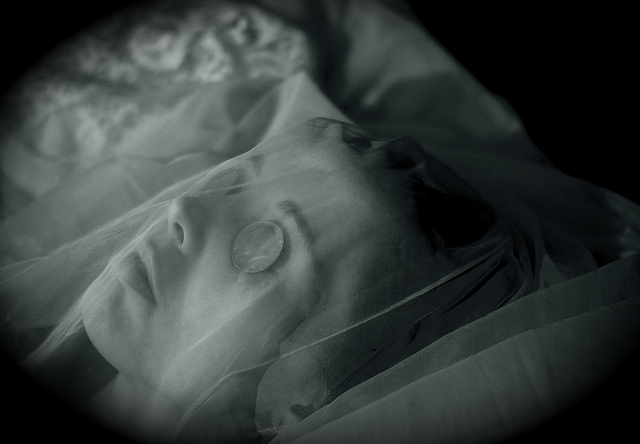
1} Place two coins (one over each eye) before you start your journey to give to the ferryman.
Your all seeing God may be waiting but just like an amusement park or a Disney film, it’s gonna cost you.
*Cancel that. Apparently they no longer accept coins and have now jimmied the price up to two hundred dollars due to inflation.
*Note 1 To The Unacknowledged: The ferryman hates the band “Styx”. So please DO NOT FUCKING sing!
2} Always carry a ham sandwich or a cream cheese bagel on your person at all times. The Ferryman can be bribed.
3} Poets ARE NOT allowed on the boat. However, if you are a critic that’s acceptable as long as you kiss ass well.
4} Hellfire. Brimstone. Satan? Perhaps you have taken the wrong turn. If this happens or this where your journey ends, then try smiling a lot and suggest a lot of your friends.
*Note 2: Hell is full of lawyers and politicians so suggest somebody else other than like your next door neighbor or an ex.
Keep your hands in the boat at all times!!!! You don’t know where that water’s been.
Bring a translation book, they all speak fuckin’ Egyptian.
*Note 3: If you are a drunk female when you pass or a gay guy DO NOT under ANY CIRCUMSTANCES lift the Ferryman’s loin cloth or robe! And DO NOT make “Boner” jokes!
And yes. Smoking IS allowed…after all well, you’re dead.
Have A Nice Afterlife !
_____________________
~ R.M. ENGELHARDT

Writers are desperate people, and when they stop being desperate they
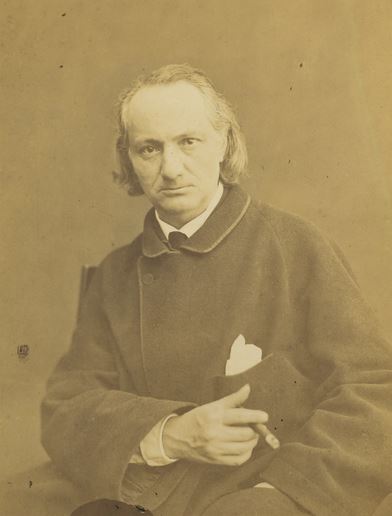
Born Today In 1821 …
Le Chat
Viens, mon beau chat, sur mon coeur amoureux;
Retiens les griffes de ta patte,
Et laisse-moi plonger dans tes beaux yeux,
Mêlés de métal et d’agate.
Lorsque mes doigts caressent à loisir
Ta tête et ton dos élastique,
Et que ma main s’enivre du plaisir
De palper ton corps électrique,
Je vois ma femme en esprit. Son regard,
Comme le tien, aimable bête
Profond et froid, coupe et fend comme un dard,
Et, des pieds jusques à la tête,
Un air subtil, un dangereux parfum
Nagent autour de son corps brun.
— Charles Baudelaire
The Cat
Come, superb cat, to my amorous heart;
Hold back the talons of your paws,
Let me gaze into your beautiful eyes
Of metal and agate.
When my fingers leisurely caress you,
Your head and your elastic back,
And when my hand tingles with the pleasure
Of feeling your electric body,
In spirit I see my woman. Her gaze
Like your own, amiable beast,
Profound and cold, cuts and cleaves like a dart,
And, from her head down to her feet,
A subtle air, a dangerous perfume
Floats about her dusky body.
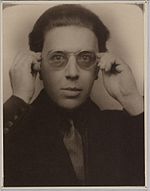
SURREALISM WILL USHER YOU INTO DEATH, WHICH IS A SECRET SOCIETY. IT WILL GLOVE YOUR HAND, BURYING THEREIN THE PROFOUND M WITH WHICH THE WORD MEMORY BEGINS. DO NOT FORGET TO MAKE PROPER ARRANGEMENTS FOR YOUR LAST WILL AND TESTAMENT: SPEAKING PERSONALLY, I ASK THAT I BE TAKEN TO THE CEMETERY IN A MOVING VAN. MAY MY FRIENDS DESTROY EVERY LAST COPY OF THE PRINTING OF THE SPEECH CONCERNING THE MODICUM OF REALITY.
~ ANDRÉ BRETON, THE SURREALIST MANIFESTO
Denis Devlin was born on April 15, 1908, in Greenock, Scotland, of Irish parents.
He entered the Irish diplomatic service in 1935 and served in Europe and the United States, before being appointed minister plenipotentiary to Italy in 1950; he was accredited also to Turkey 1951, and was ambassador to Italy 1958.
Admired by Beckett, who described him as ‘without question the most interestering of the youngest generation of Irish poets’, his books are Poems (with Brian Coffey, privately printed, Dublin, 1930); Intercessions (London, Europa Press, 1937); Lough Derg and Other Poems (New York, Reynal & Hitchcock, 1946); Exile and Other Poems (New York, Pantheon Books, 1949); Memoirs of a Turcoman Diplomat (Rome, Botteghe Oscure XXIV, 1959); and his posthumous Selected Poems (New York: Holt, Rinehart & Winston, 1963). The Complete Poems of Dennis Devlin, edited with an introduction by Brian Coffey, was published in the University Review, Dublin, Volume III, number 5 (no date given), and by The Dolmen Press, Dublin, 1964.
His later posthumous books are Selected Poems (Dublin, New Writers’ Press, 1971); Collected Poems, edited by J.C.C. Mays (Dublin, Dedalus Press,1989); and Translations into English [from French, German and Italian poetry] edited by Roger Little (Dedalus Press, 1992).
He died in Dublin in 1959.